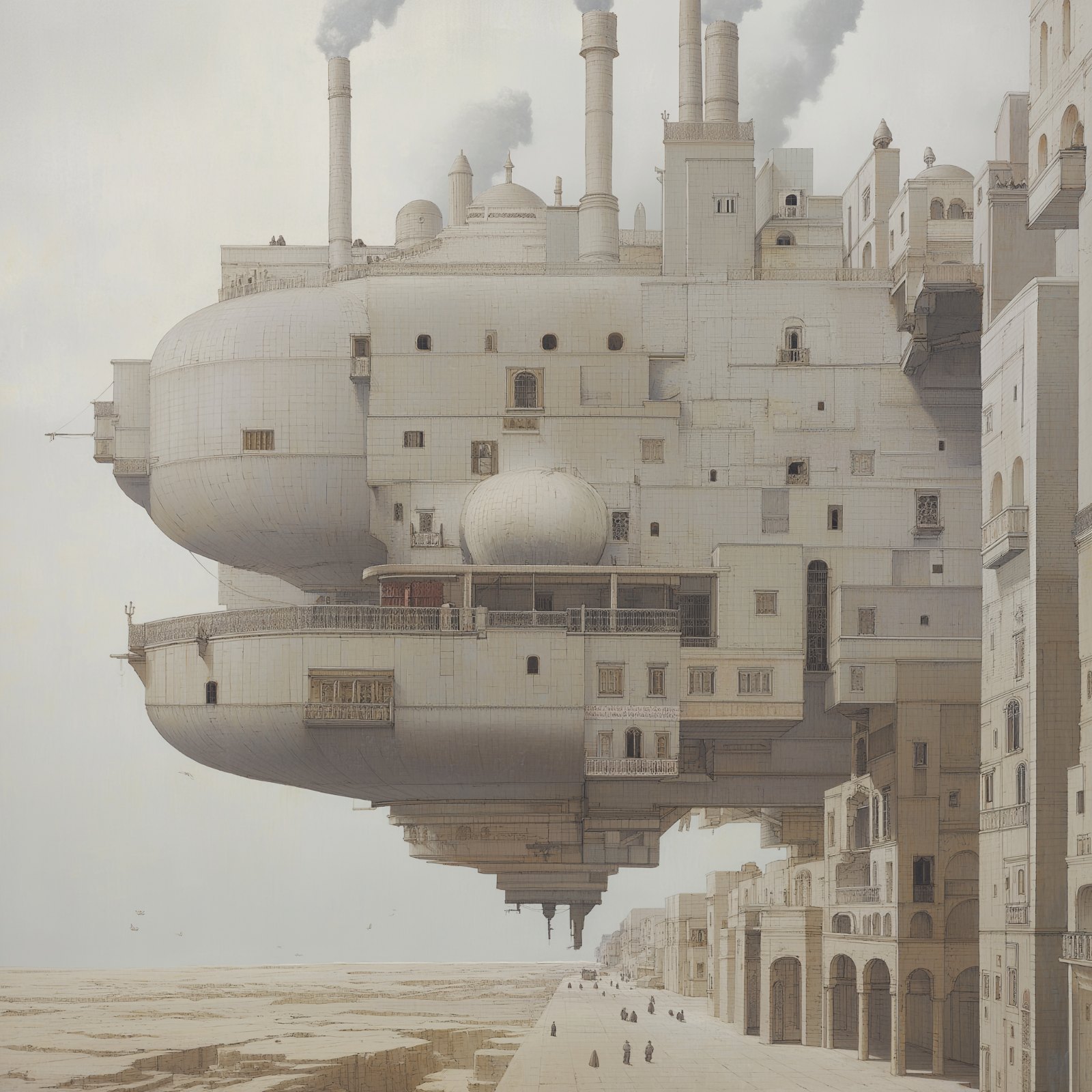
Invisible
Cities
Imagining the architecture of places that exist only in words.
Italo Calvino, 1972 — a visual project by Cristina Popescu
Imagining the architecture of places that exist only in words.
Fifty-five cities that do not exist, and yet speak of the world we live in.
In Invisible Cities, Marco Polo describes to Kublai Khan impossible cities built of desires, memories, signs, exchanges, fears and contradictions. Imaginary places that, through architecture, speak above all of the human condition.
This project was born from the desire to walk through those cities: to give a face to what Calvino left to words, and to return — one city at a time — the feeling of having visited them.
Each city takes shape in ten visions: fragments of a place that never existed, held together by a piece of music chosen to convey its atmosphere. Like the distant memory of a dream, the cities are first imagined and only then entrusted to artificial intelligence, which translates them into images.
The images are generated with Midjourney, but the process does not end with generation: each city is born from research on the text, from identifying its symbolic and spatial elements, and from a long selection and composition of images. Artificial intelligence thus becomes a tool for exploring places that never existed, seeking to convey not so much what they look like as the feeling of having been there.
Cristina Popescu is an architect and co-founder of Atelier Croquis in Lugano.
Her work stems from an interest in space as a narrative tool: not only what a place is, but what it manages to evoke, recall or make one imagine.
Invisible Cities grew alongside her architectural practice, as a personal inquiry into the relationship between word and space, reality and imagination, memory and design.